
How To Use The Nashville Number System
ByDan Wilt
You've probably had the experience- you're in the middle of a rehearsal, and you need to change the key of that song. "Should I or shouldn't I?" you silently ask yourself. You must. You simply must. So, sheepishly you suggest that the song must be put into a different key.
3 things inevitably happen at this point:
 The Nashville Number System: A Basic Approach
There is a better way, and it's called The Nashville Number System (NNS). I've created a very basic version of it for handing out to your teams to get you started– download available here. Musicians all over my city use the NNS in the studio and in live settings to communicate musical changes quickly.
The basic principle is this. Each chord in a key has a number assigned to it. Many songs are fairly simple in their chord structure. In my world of worship music, this is often the case.
The I chord (1), IV chord (4), V chord (5), and vi (6m) chord are the most common. I won't get into all the details here, but if you know these chords for one key, in your head, you are ready to go.
Example In The Key Of G
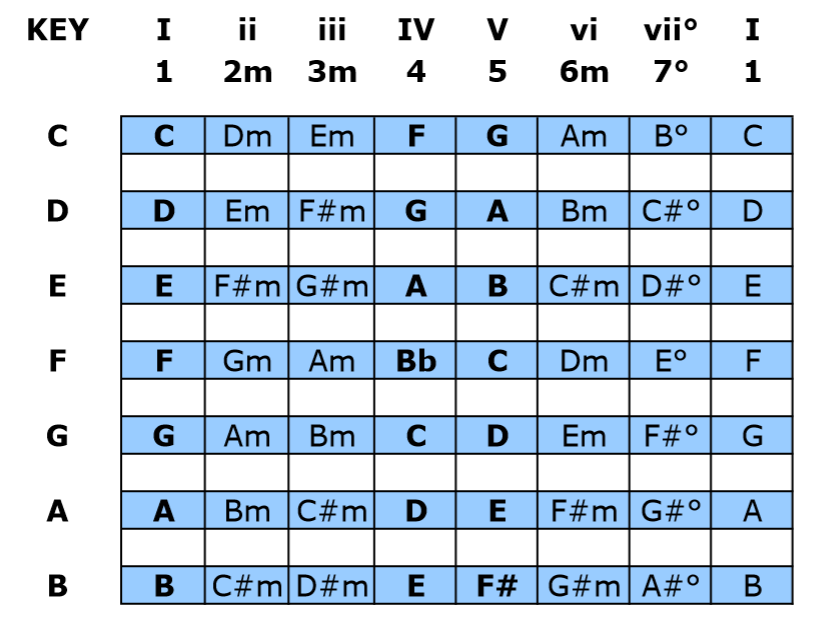
Study the chart above as you read this next part.
First if a song is in the key of G, and you see the G (I), the C (IV), the D (V), and the Em (vi), you have your chords. Now, as an exercise, print out the chart and use white out to change the G chord to the number 1 (which is the same thing as the Roman numeral I), the C chord to the number 4 (IV), D to the number 5 (V), and Em to 6m (vi – lower case means the chord is minor rather than major).
Done? Now play the song, memorizing the numbers rather than the chords. Now, you are ready to transpose.
Look at the chart. Go to the key of D. The D is the 1, the G is the 4, the A is the 5, and the Bm is the 6m. Simply play the chords as numbers, in the same spots as the others. Then, start trying to play the song, just based on the numbers in a few other keys.
Now, take a few songs that are very familiar to you and change the chords to the numbers in the chart below. Practice until the numbers for each key start to get in your craw.
After a few weeks, this will start to be a huge game changer.
Start Talking In Numbers In Rehearsal
Get your musicians familiar with hearing you say numbers instead of chords. If you're in the key of G, and you want the team to go to the C chord, say "to the 4"³ rather than "go to C." Do this over months, and the band will start to get it. If they memorize their I, IV, V, and vi chords for each key, you're most of the way there.
Once you all learn the Nashville Number System, changing keys (and playing better by ear) will seem infinitely easier.
WorshipTraining has a great 7-minute Video and PDF Nashville Number System Tool with which you can now train your band for those harrowing moments. No more crying from the newbie – once you learn the Nashville Number System, there will be only hugs and joy when you change that key.
See the Nashville Number System (NNS) Video and PDF Tool and don't forget that you can transpose all your purchased chord charts on PraiseCharts.com
- Smiling - The professional musicians smile, and turn their chart over. They think they can just play it by ear. But you changed some of the chords from what they might "intuit" should happen next in the verse. Trainwreck.
- Jaw-Dropping - The able musicians, who are not professionals, drop their jaws, grab their pens and frantically begin to scratch out the old chords in the old key to replace them with the new chords. They use their fingers to count out loud to figure out which chord comes next.
- Crying - The inexperienced musicians just sit down, cry, and occasionally glare up at you for changing the key.
The Nashville Number System: A Basic Approach
There is a better way, and it's called The Nashville Number System (NNS). I've created a very basic version of it for handing out to your teams to get you started– download available here. Musicians all over my city use the NNS in the studio and in live settings to communicate musical changes quickly.
The basic principle is this. Each chord in a key has a number assigned to it. Many songs are fairly simple in their chord structure. In my world of worship music, this is often the case.
The I chord (1), IV chord (4), V chord (5), and vi (6m) chord are the most common. I won't get into all the details here, but if you know these chords for one key, in your head, you are ready to go.
Example In The Key Of G
Study the chart above as you read this next part.
First if a song is in the key of G, and you see the G (I), the C (IV), the D (V), and the Em (vi), you have your chords. Now, as an exercise, print out the chart and use white out to change the G chord to the number 1 (which is the same thing as the Roman numeral I), the C chord to the number 4 (IV), D to the number 5 (V), and Em to 6m (vi – lower case means the chord is minor rather than major).
Done? Now play the song, memorizing the numbers rather than the chords. Now, you are ready to transpose.
Look at the chart. Go to the key of D. The D is the 1, the G is the 4, the A is the 5, and the Bm is the 6m. Simply play the chords as numbers, in the same spots as the others. Then, start trying to play the song, just based on the numbers in a few other keys.
Now, take a few songs that are very familiar to you and change the chords to the numbers in the chart below. Practice until the numbers for each key start to get in your craw.
After a few weeks, this will start to be a huge game changer.
Start Talking In Numbers In Rehearsal
Get your musicians familiar with hearing you say numbers instead of chords. If you're in the key of G, and you want the team to go to the C chord, say "to the 4"³ rather than "go to C." Do this over months, and the band will start to get it. If they memorize their I, IV, V, and vi chords for each key, you're most of the way there.
Once you all learn the Nashville Number System, changing keys (and playing better by ear) will seem infinitely easier.
WorshipTraining has a great 7-minute Video and PDF Nashville Number System Tool with which you can now train your band for those harrowing moments. No more crying from the newbie – once you learn the Nashville Number System, there will be only hugs and joy when you change that key.
See the Nashville Number System (NNS) Video and PDF Tool and don't forget that you can transpose all your purchased chord charts on PraiseCharts.com